Showing posts with label Spring semester. Show all posts

Wednesday, 9 July 2014

# 12 Rotterdam School of Management, Erasmus University (RSM)


      Rotterdam, The Netherlands

Kralingsen Plas

      1. The Netherlands


Small country with a peculiar weather, get use to rain and sun in the same day and it is always windy. Your best friend will be the weather apps. 
The trains work very well therefore you can visit other cities in The Netherlands (Utrecht, Maastricht, Amsterdam, Delft, Den Haag, and others) and also visit Belgium ( Rotterdam – Brussels is around €20). Download the app 9292 or check the website 9292.nl to have access to train and trams time table in the entire country.


      2. Rotterdam

Rotterdam is a very nice city, with modern architecture and wonderful terraces to enjoy the sun. The city center is small, bike is the best transportation

2.1 ‘My’ best places

·         Kraligen Plas – to jogging, to have a drink or do a barbecue

·         Blaak Market – every Tuesday and Saturday

·         Cubic Houses – the icon of Rotterdam

·         Erasmus Bridge

·         Euromast 


Erasmus Bridge

2.2 Transports

Everyone has a bike, however don’t forget to buy a good locker otherwise you will get yours stolen. You can buy one in the fb groups like Rotterdam Commodity Market, by asking for it or replying to one of the innumerous posts. 
To use the tram you can buy in the central station or in other big stations an anonymous Ovi-chipkaard (check the website: https://www.ov-chipkaart.nl/aanvragen/), costs 7.5€ and you can put credit on it. It gives you cheaper travels otherwise you have to buy a single ticket that costs €3 (normally one travel with the ovi-chikaard costs around €1.5). 


2.3 Restaurants

As you may guess, The Netherlands is not the cheapest country, especially when compared to Portugal. Nevertheless the biggest difference is felt in the prices you pay in restaurants or clubs/bars. . 
You can find a huge variety of cuisines, but the classics are the Italian restaurants: VIP (Very Important Pizza), Happy Italy, Vapiano, and others. A cheap alternative is also enjoying the many fast food roulettes in the middle of the street. A especially note for the Rotterdam famous invention named Kapsalon that you can find in Kebab stands. For the ‘desert’, go near Blaak and try the poffertjes (mini pancakes) and also the typical cookie with sweet cream inside. 


2.4 Supermarkets

The biggest chain is Albert Heijn (very similar to the Pingo Doce in Portugal). However if you want cheaper supermarkets you have others like Aldi. But to buy fresh (and cheaper) vegetables and fruit go to the market every Tuesday and Saturday at Blaak, it is the best. 


2.5 Nightlife

Because we know study is not everything, it is crucial to talk a bit about the parties and the nightlife in this review. Despite from what you may think, we believe it is perfectly doable to combine the workload of the university with your mental sanity, meaning parties.

The key for your mental sanity to stay intact is to have a good CEMS Club, which you may be part of, if you want. This body is of outmost importance because they are the only ones to organize the social activities for you.

Concerning clubs/bars, there are a few interesting options in Rotterdam. In the end, you will spend the majority of your Tuesday’s nights in a club called BED, where ESN organized a weekly international party with very cheap beer.

Going in detail, the following activities were the ones we had during the semester:

·         Carnival in Cologne

·         Trip to Ireland (Dublin)

·         Cycling dinner

·         King’s day

·         Pub Crawl

·         Karaoke night

·         Marathon

·         Barbecue

·         Paintball

·         Several dinners and clubbing nights

Along with all this activities, we also had a few sustainable and corporate initiatives such as volunteering days with homeless or mental disable people and company presentations and tours.

A special note for King’s day - a ceremony that marks the birth of the King Willem-Alexander. This event happens every year on April 27th and is one of the most known parties in the Netherlands. It is a daily party, celebrated from morning till the time you can’t walk anymore and the craziest action takes place in Amsterdam. Definitely a most!


    King’s day in Amsterdam
      3. The University

Don’t be confused by the name of the faculty, “RSM”, vs the name of the university, “Erasmus”. Unlike what it may seem, the most famous university in Rotterdam is not named after the many students it receives in the Erasmus exchange program, rather by the Dutch Renaissance theologist Desiderius Erasmus. Within this huge university – with over 20,000 students – stands the business and management faculty, called RSM.

It is often heard by CEMS students throughout the world that NOVA and RSM are similar in that they are two of the most demanding universities of the program. Although I have not studied in all the others, from the 5 universities I attended throughout the past years, I have to admit that RSM is very good academically. 
I attended three courses: “Management Challenges in International Organizations” (the mandatory course), “Corporate Governance and Strategic Leadership” and “Climate Change Strategy Role Play”. They were all quite interesting, challenging and had excellent teachers. However, one of the only problems we faced at the university was the grading systems. Although their scale is from 1-10 (easy to convert into Nova’s scale of 1-20) it is extremely difficult to achieve their “cume laude” grade of 8.5, which is equivalent to Nova’s grade of 17.


3.1  International Business Projects (IBP)

Regarding the International Business Projects (IBP) at RSM there are around 12 different projects, grouped in teams of 4-5 students, typically from very different nationalities. The difference of RSM’s IBP system, to that of other schools, is that you do not get to select your favourite. You receive a survey, some months in advance, asking what subjects and industries you would prefer to work with, but you do not even know the companies/subjects until you get there. 
From the three of us who were in RSM last spring semester, we got IBP’s with Siemens (myself), CARE Nederland (Beatriz) and Berenschot (Miguel). I was extremely lucky because my group got to travel to Spain and the UK as part of the data collection process for our project and I had a great Academic and Company coach. However this is not always the case – feel free to contact us personally for more specific details regarding other projects.

Overall, I really enjoyed the university and I believe I speak for the three of us when I say that Rotterdam is a great choice of CEMS exchange city, particularly if you want a great “academic stamp” on your CV!


3.2 Campus

The University campus is amazing! Since 1 year ago they are improving the facilities and trying to increase the sustainability of the campus. As a result, it is super green, there are lakes everywhere and the atmosphere is cool. Some of the facilities include:

·         Starbucks

·         Sports Center (gym, football and tennis fields, classes…)

·         Several restaurants, including a totally renewed area.

·         Pub

·         Supermarket


In addition, if you are trying to find a place to live, I recommend you the U-building, also known as Hatta Building. This is a 15-floor building inside campus only for international students to live. It is cool because you have everything you need in a 5-minute walking distance from you and the environment is very friendly. Nevertheless I would try to ask in the CEMS Facebook group if someone is thinking about staying there because in my year we were we were 12 CEMS students living there and that obviously made the experience much better.


Erasmus University Campus
----


By Beatriz Gonçalves, Miguel Vale and Patricia Weigert,Class of 2013/2014

Term Abroad - Spring 2014

Thursday, 19 September 2013

# 7 University of Economics, Prague (VSE)

Overview of VSE’s main campus and main hall


University of Economics, Prague - Prague, Czech Republic


The faculty of VSE is somewhat a mix between academic courses and more practical ones. Indeed, some teachers you will have are very much academic oriented and the theory is crucial for the final exams.  On the other side you might encounter some teachers – mostly visiting teachers – who do not care for exams but instead demand individual papers, throughout the course. 
The semester starts in February and officially ends in late June. I say officially because I was able to finish in May, so this might be a problem for those of you who tend to come here with an Erasmus grant, as you need to give the exact dates of your official stay at VSE. Since the Exchange office here in Prague considers the day of your last exam as the end of your official stay, I would advise you to contact them when you are applying for the Erasmus grant and explain the situation beforehand in order to avoid unnecessary red tape on your return!  


As for the courses offered here at VSE, they tend to be fairly stable over the years so you might except to find the same:


Courses offered Spring Semester 2013:
Course Name
ECTS
Accounting Information for Financial Management
6
Business Strategies
3
Corporate Finance
7
Elementary Czech for Foreigners
6
Entrepreneurship and New Business Venturing
7
Financial Derivatives I
3
International Financial Markets - in English
3
International Marketing CEMS - in English
7
International Marketing Management System Online (GMMSO): Planning and Strategy
3
International Strategy (in English)
7
Introduction to Economic Analysis of Contract and Corporate Law
4
Joint Ventures and Multinational Corporations
6
Management and Business Communication Skills Seminar
1
Maritime and Multimodal Transportation
6
Multicultural Europe
3
New Trends in Leadership and Management
4
People Management in Multicultural Environment
4
Psychology of Management
7
Purchasing
4
Strategic Marketing in Simulations
4
System of Intensive Development of Individual Abilities
4
  

The main difference with Nova can be found in the fact that there are no short courses, since the semester is not divided in two parts, as such all courses last for the duration of the whole semester. The only exception to that are the intensive courses which are worth 3 ECTS, and normally last 3 days. Now this might seem as a nice trade-off, but they normally require a lot of work after the course. In my case we had to come up with to come up with a business strategy for a new company, with everything in mind – from HR policy, to a financial analysis of the next 5 years – all of this in 15 to 20 pages, during the BP final phase. 

A final warning considering the grading system here at VSE, their grade conversion for the CEMS is different: 


So in order to get an A in your CEMS diploma you will need to finish a course with 18,6! Also there is no rounding up your grades.


The Business Project offer here at VSE is pretty diverse, although we had this year a very strong presence of Marketing and social media subjects. It is also noteworthy that last year’s best BP was from the VSE.  List of BP this year:


  • ABB - Way from analysis of social media environment through recommendations to story for infographic
  • Google - Building strong brands online (Participate on the brand strategy creation for one of the top Google client)
  • "Komerční banka - Impact of a “Regulation (EU) No. 260/2012 of the European Parliament and of the Council of 14 March 2012 establishing technical and business requirements for credit transfers and direct debits in euro and amending Regulation (EC) No 924/2009” to non Euro countries (focused on Czech republic)"
  • L´Oréal - Analysis of e-commerce cosmetics business in the Czech Republic and construction of a LOréal e-commerce business plan
  • McKinsey - Opportunities for Private Equity at the dawn of Healthcare reform
  • Plzeňský Prazdroj - Communication of beer brands on Facebook
  • Plzeňský Prazdroj - How to get young people 18 – 30 from their online life to real consumption (pubs, bars, hypermarkets, etc.)?
  • Procter&Gamble - Gamification strategy for eCommerce
  • Unibail-Rodamco - How to stay the leading edge operator in the real estate industry?
  • Unicredit Bank - Behavioural analysis on dynamics of clients indebtedness
  • Hilti – Management and profitability steering of technical campaigns


I have to say that in my case (McKinsey project), our advisors both academic and from the company, were always present for us and we had meetings with them twice a week, sometimes at 7h00 in the morning. Although tough the whole experience was very positive and from what I have heard from other teams the general feedback was pretty positive as well.


In terms of living in Prague, I have to say that although I had already worked in the city previously being here as a student is a totally different experience. 

First of all the city is very cheap in terms of restaurants and living expenses (my only advice avoid the city center, it’s a tourist trap and prices tend to double or triple…). Public transportation are cheap (around 30€ for 3 months all transports included) and excellent, as day trams end their shift at midnight and night trams start at 23h30 and run every half hour all night long. So whenever you’re out in a bar or club you shouldn’t worry that much about transportation, just be sure to be appropriately dressed in the winter. 

There is always a huge community of Erasmus students and as such there are a lot of activities for them, also the CEMS club is very active and there are events organized almost every week (cocktails, parties, corporate events…).

Communism still present in the mind of Czech people :)
 
The people in Prague are generally friendly and are able to speak English as they are lots of tourists all year long, but sometimes you will fall on some unfriendly staff, especially in the subway. If by any chance you find somebody who does not speak English at all (VSE library personnel for example), you should go for German as a lot of elderly Czech speak the language.

In terms of housing, it will be difficult for you to find anything if you are not personally visiting the places and I would advise against renting anything before you see the place, as there are lots of scams (some CEMS students were victims of this). My advice would be to come to Prague one month before the start of the semester and visit some places, also avoid agencies as they tend to overcharge a lot, typical prices for a good flat go around 300-400€. 

            Less than 1€!                       Czech food can be a bit heavy!
 
Food wise the faculty has 3 cantinas, and prices are around 2€, but as I told you before, restaurants are cheap, you can have a lunch in good restaurant for less than 5€, and in some excellent restaurants for less than 10€ (no cheap fish though…). Also for smokers do not expect to quit smoking in Prague as prices are very low: Marlboro red costs 3.45€ ;)!


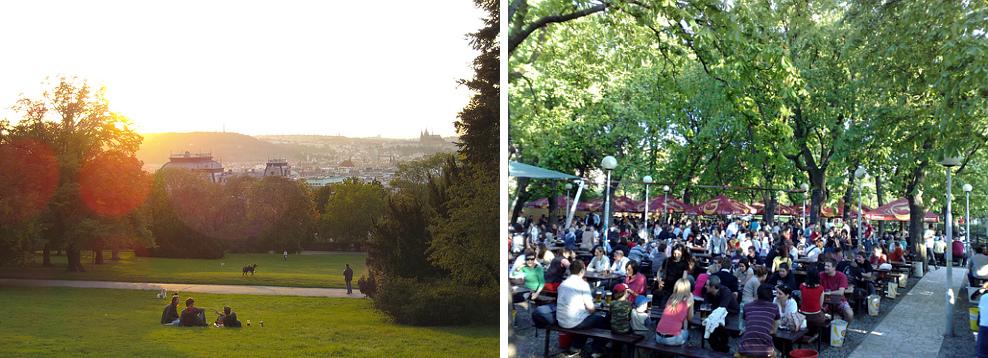
Riegrovy Sady and its beer garden – 2 minutes’ walk from the faculty

Prague is also full of parks and beer gardens; actually one is located behind the faculty and has an amazing view of all of Prague, which is pretty nice when you want to go have a drink or just relax. 

Overall I would have to say that the city is well prepared to welcome foreign students and if you ever encounter any problem during your stay you can always count on the friendliness of both the CEMS office and the CEMS club.

P.S. study carefully VSE’s intranet (ISIS), it can be complicated sometimes, but is really useful once you get used to it.

---

Samuel Eric Antonio da Cruz Teodosio Marques, Class of 2012/2013 
Term abroad - Spring 2012